I’ve been doing a ton of writing; I have lots of thoughts running around loose in my head. However, I’m not ready to go into detail, at least not without diving into what brought me to himdag (him-ee-dawk). So I guess explaining what it means is where we’ll start. I first heard the word himdag while in high school between my junior or senior year from an O’odham boy I had taken college courses with and briefly dated. I was dead-set on pursuing an academic career in Anthropology and obsessed with wanting to join the military. Nisije’e (Knee-see-juh-uh, mother) had made it clear she didn’t care either way if I graduated. Nisiohg (Knee-see-awks, father), along with every other person in my life, wanted me to pursue art, writing, and even music. Everyone saw me in an artistic career doing what they thought I was exceptionally good at; I saw myself going to the military with degrees in Anthropology and Psychology. Now someone might be reading that and thinking that I’m asinine and asking questions such as; “You have a supportive family that wanted you to pursue your artistic talent?” “How could that possibly be a baaaaaaaaad thing?” “Are you sure you’re not just a whiny crybaby?” You may even be thinking; “You’re a whiny crybaby, and I’m never reading this blog again.” To which I gif this:
In all seriousness though I was maybe too mature for my age. The way I processed my world was not through the eyes of a child. It was with worry and concern for the future and being responsible. I knew I had to be responsible for my siblings, be responsible for me, and be responsible for my parents. Instead of pursuing dreams and passions, I wanted an academic and well-paying career; not only that, I had plans to join the military immediately after high school. The only advice I heeded was from my paternal grandparents: getting a bachelor’s at a minimum before the military so my rank and pay would be higher.
My only goal for a long time was “take care of my siblings,” work hard, and don’t be a fuck up. Don’t fail at life, don’t end up poor or broke. Don’t chase a dream and ignore everything else, don’t just give up and live off the government. Practical people, I respected also encouraged me to follow my artistic aspirations. Even though Ni-Komalwu (Knee-co-mall-woo, guardian mother) and my Grandmother tried to convince me to pursue it as a career, I refused. I didn’t want to end up a broke artist or struggling because I chased a dream that didn’t end up helping me feed my family. They understood the “why” it was an emotional response. I remember crying to both of them that I didn’t want to end up like my parents. To me, that’s what the arts were, pipe dreams for only the most exceptionally talented and/or lucky, which meant I was excluded. In hindsight, for most of my childhood, Nisije’e made sure that I knew I wasn’t special, that no one cared, that every person was against me. A friend recently told me the inner voice you hear as an adult comes from the people that raised you. It made sense because I’m a naturally optimistic person with crippling depression. This phenomenon is known as the critical inner voice and I plan to share more about it in the coming weeks.
So long story short, Nisi-ohg’s inefficacious music career wasn’t inspiring me, and I was fighting tooth and nail for my life against the critical inner voice I heard. It was these factors, around the ages of 12 or 13, that I decided to pursue a career as an anthropologist. Around 8th grade, a show called Bones came out, and I thought that was a respectable academic career. I could keep art as a fun hobby and maybe even use it to pursue anthropology. This drive is how I started college at 17, a couple of days after walking in my final graduation ceremony. (I was honored to do it 3 separate times and get my money’s worth on the gown).
See, the O’odham boy had told me we were all walking a similar path, the path of life, and we’re connected to everything through himdag. Traditional himdag is about working with yourself, your environment, and your community and creating balance. These principles are Art, Belief, Community, Games, Harvesting, Language, Land, Medicinal plants, Mobility, All Time, Relatives, Songs, Storytelling, Spirituality/Religion, Sensitivity, and Values. There are 16 principles, and you create balance by incorporating all of them. In traditional teachings, not balancing himdag makes you sick and hinders you on your path because himdag is “the” lifelong journey. It’s quite literally a circle. That’s about the extent of my knowledge (so far). The more I learn about what it means to be Tohono O’odham, the more I realize that the rest of what it means is up to me. Not just as an individual but even as I relate to my family and those around me.
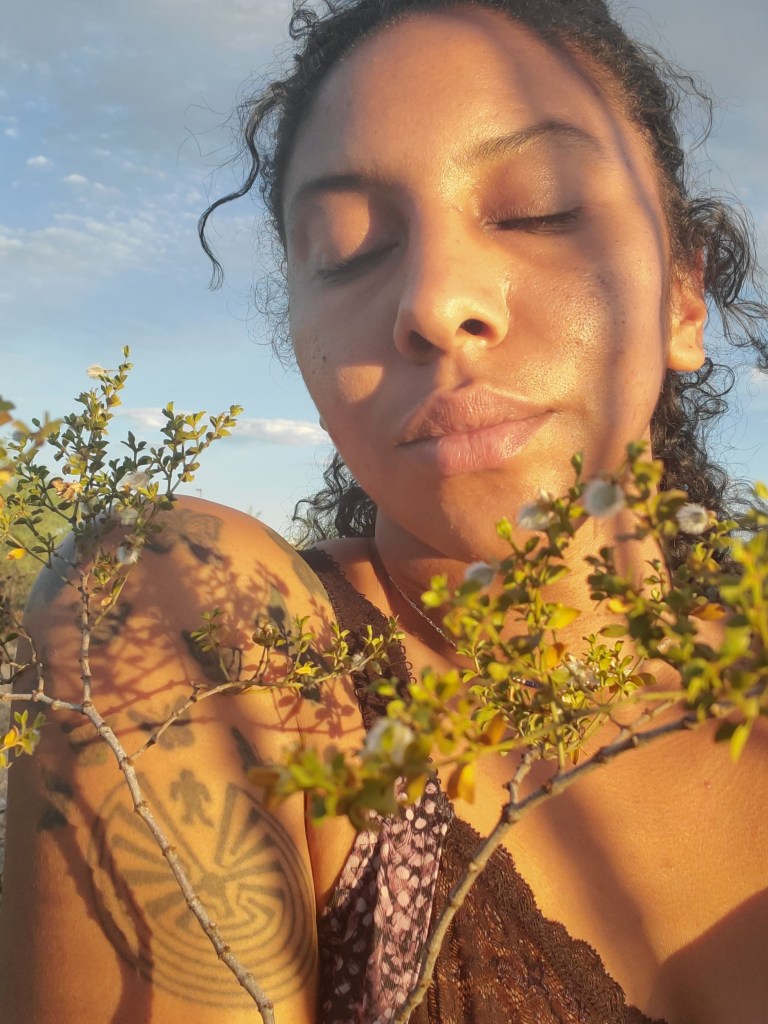
(Pictured here is my tattoo of the man in the maze surrounded by creosote.)
There are actual songs, stories, and ceremonies that I’m yet to learn. They can vary from district to district, clan to clan, or family to family. I’ve been watching and following various people recording our language to teach it on YouTube. Even the ways of saying our words, it’s very much on you to convey it the best way you can so that the other person understands. It doesn’t matter how you say it as long as the intent is clear. It’s a beautiful approach to language if you ask me. We’d have more honest interactions if we first approached people with our intentions.
So what is himdag? Himdag is about finding balance on the journey of life. The more important question is what I plan to do with this. I’m taking the eastern approach to incorporate our traditions into this modern world. Finding himdag is not just discovering our language, customs, and stories but integrating them into my daily life. I’m slowly rolling out these blog entries because I’m slowly working on myself. Truthfully, I allowed myself to get derailed the last couple of months. Still, even that is just another part of my journey, another lesson I can share. I recently underwent my second ketamine booster, and I see my world clearly. I have daily realizations about the type of person I am, was, and intend to be. I’m fired up about writing again and plan to be back on track to post regularly.
I look forward to sharing the next step in my journey. I plan to dive deeper into how learning to speak O’odham is changing how I think and plan to do things going forward. If you’re interested in learning the language, I’m including the links to the videos so you can learn and/or listen.

 finding himdag
It’s one of the hardest journeies to be on to find that piece. Only in steps can we reach. I’m with ya on that. And reaching for it myslef
LikeLike